




How to prepare a claim for an extension of time

|
Contents |
[edit] Introduction
Construction contracts generally allow the construction period to be extended when there is a delay that is not the contractor's fault. This is described as an extension of time (EOT).
When it becomes reasonably apparent that there is, or that there is likely to be, a delay that could merit an extension of time, the contractor gives written notice to the contract administrator identifying the relevant event that has caused the delay, requesting the extension of time, presenting the reasons, and referencing the contract clause that allows the request. This letter is then assessed by the contract administrator (perhaps with input from the consultant team) before approval or rejection. If it is approved, the letter is given a written answer, and a change order is issued.
Sometimes, contracts may require the submission of requests within a specific time, otherwise, they can be rejected.
For more information, see Extension of time - approval letter example.
Proving delay and/or disruption can be a complicated and time-consuming process, and the quality of the information provided and the records available are often the key to successful claims. The claim should adequately establish both causation and liability, as well as the extent of the damages/disruption experienced by the contractor as a direct result of the delay.
To be able to do this effectively, the contractor should produce an accurate baseline programme before work begins, for progress to be monitored. The programme should show the planned productivity rates for the different work activities and appropriate benchmarks. As construction projects are naturally dynamic and subject to change, the programme should be continually updated and revised to reflect the current project conditions. This can enable the contractor to determine what effect a delay is likely to have on their ability to complete activities, making it easier to prepare their claim.
All events and issues which either cause, appear to cause, or have the potential to cause delay should be recorded by the contractor, including:
- When the event occurred.
- Why it occurred.
- The tasks that it affected and the reasons why.
- The resources that it required.
- A list of the affected activities from the schedule.
- Any other activities that were carried out, either on- or off-site, as a result.
- Sketches, photographs and plans.
- Details of actions taken by the contractor to avoid or minimise delays.
- Alternative solutions and/or a proposed recovery plan.
- Communications between the construction team relating to possible delays.
It is important that this is done at the time, as recording the causes of details of a delay retrospectively is often very difficult and time-consuming.
All costs which are associated with delay events should also be recorded wherever possible. Demonstrating a causal link between an event and subsequently incurred costs will make it more likely the claim will be approved.
The submitted claim should be concise, accurate and as clear as possible. It should explain the delay event and the sequence of events surrounding it, all of which should be cross-referenced to records, i.e. the programme. Retrospective delay analysis should be avoided if possible and used with caution if necessary.
Claim requests should also consider the following:
- Working days are different from calendar days.
- The reissuing of insurances and other bonds to cover extended periods.
- Summer days tend to be longer and more productive than winter days.
- Whether the extension of time being requested will be sufficient to cover all delays.
- The nature of the proposed changes and their ramifications.
- Once an extension of time has been approved, no additional time will be granted for the same item.
- Only one claim is necessary for a continuing delay.
[edit] Delay analysis methods
It is essential to analyse and present the exact impact due to the delay events. Delay analysis methods are used to analyse and present these impacts. The most popular delay analysis methods are:
- Impacted as-planned.
- Collapsed as-built.
- As-planned vs as-built.
- Time slice windows analysis.
- Time impact analysis.
- Longest path analysis.
[edit] What the contractor is entitled to claim
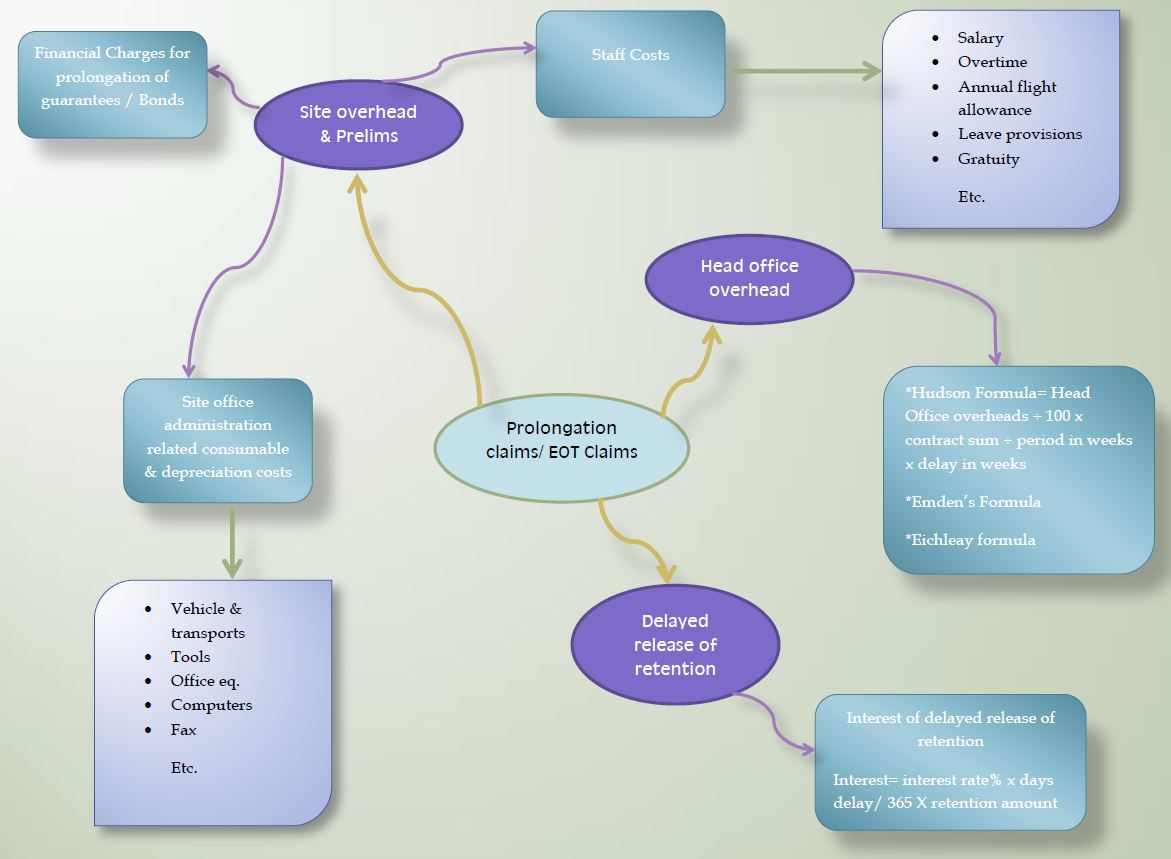
The contractor is entitled to claim the following essential costs:
- Site office costs.
- Site overheads.
- Head office overheads.
- Finance and insurance-related costs.
[edit] Related articles on Designing Buildings
- Acceleration of construction works.
- Change order.
- Common refusals of extensions of time.
- Compensation event.
- Contract administrator.
- Contract claims.
- Delay damages.
- Extension of time.
- Extension of time - approval letter example.
- Practical completion.
- Project programme.
- Time certainty.
- Time Risk Allowance TRA.
- Variations.
[edit] References
- Quantity Surveyor. (2019). Quick Guide to extension of time claims (EOT Claims) · Quantity Surveyor. [online] Available at: https://quantitysurveyor.blog/2019/10/26/quick-guide-to-extension-of-time-claims-eot-claims/ [Accessed 29 Oct. 2019].
Featured articles
Check out some of the best features and news from Designing Buildings as well as key stories from around the web.

Government approach could undermine delivery and regeneration.
World's first mass timber data centre.

The overlooked environmental aspect of data centre development.
Introduction to radon awareness

New technical information sheet published by CIOB.

Updated supplier guide can help electrical contractors engage with NHP.

CIAT confirm the winners of the 2026 architectural technology awards.

Government launches a one stop shop for flood preparedness.

Sir Edwin Lutyens: Britain's greatest architect? Book review.

CIOB publishes free template to help assess and manage risks.
ECA's reflections on Party Conference season

Burnham wants to be confident of winning before asking for a fresh mandate.
New Chief Construction and Scientific Adviser

Sergio Cavalaro, Professor of Infrastructure Systems at Loughborough University.
Building safety levy for England

CIAT publish estimator tool for members.

Water sector faces a growing crisis that could slow the delivery of vital infrastructure.